Pages

Showing posts with label .Book Reviews. Show all posts

Tuesday, November 29, 2011

"Fate's Edge" by Ilona Andrews-- Fun, but Contrived

     I've been a fan of Ilona Andrews ever since I read On the Edge, the first book in "The Edge" series. Despite my sometimes finicky attitude toward paranormal fiction I like the genre when it's inventive and well written and I was really looking forward to Fate's Edge. But, like too many of my favorite urban fiction favorites, I fear the series is starting to buckle under the weight of too many contrivances.


     Audrey Callahan is a former thief with the magical ability to open locks-- an ability and a life she is trying hard to leave in the past. But when her father begs her to do "one last job" while wielding the all-powerful weapon of familial guilt as leverage, Audrey agrees to a heist that ultimately brings her to the attention of some very dangerous people.

     Kaldar Mar is a rogue, gambler and thief who has turned his less-than-legal talents to use as a spy. After Kaldar is assigned to track down the items stolen by Audrey he soon discovers that in the wrong hands they could be a powerful weapon, and the only way to get them back is to track down the thief who stole them in the first place.

     As in all books set in the world of "The Edge" Kaldar will have to travel between the magical realm known as The Weird, the non-magical world known as The Broken as well as the in-between world of The Edge where magic is unreliable at best. Only this time Kaldar has the unexpected complication of some uninvited guests...


     Kids and pets-- the old cliche in movie making is to avoid kids and pets. Maybe that should be the new caveat in writing fiction as well. I'm as likely as anyone to be charmed by precocious kids and anthropomorphic animals-- who wouldn't be after growing up on Disney films? But these tropes that can quickly become overused; especially if a book features more than one. "Fate's Edge" has new adult leads but brings back the youngsters featured in "On the Edge." This time around George, a young necromancer, and Jack, a young lynx changeling, stowaway on Kaldar's transportation as he leaves on his mission to find the stolen items. Naturally, they are prompted to leave home due to misunderstanding that has Jack convinced he'll be sent off to a particularly bleak military school and the kids go through the requisite growing-up experiences on their adventures-- including the rescue of a mistreated cat. And just in case one abused animal wasn't enough, Audrey also has an uncommonly loyal raccoon that follows her around after also being rescued in infancy. None of the story-lines become too cute but there is a small feeling that the book was somewhat written by rote with all the guaranteed ingredients thrown in to ensure its likability.

     And one has to look no further than the main characters to see more personalities that fit into cookie-cutter roles as well. Kaldar, as a former thief and notorious womanizer, is a leading man we've seen many times: the perfect fantasy for women who dream of being able to tame the bad boy.  Audrey is the woman we'd all like to envision ourselves as being: perfectly gorgeous and always ready with the quick comeback. Neither character is poorly written and they have a believable chemistry. The dialog is brisk and clever and it's a book you'll enjoy reading even if it feels slightly predictable.

     I hate to offer a negative review of an author (or team of authors in this case) that I really like, but if I'm impressed by an author at one point I am also someone who expects a certain level of quality in subsequent books. "Fate's Edge" has a certain style to it that should appeal to fans of Andrews' books but I was left feeling that this one was a half-hearted attempt. Not only were the characters somewhat stereotypical, but the plot didn't always flow from a logical progression and had a cut-and-paste feel to it. Characters that are known from previous books and built upon the foundation of familial loyalty are quick to abandon the main characters with the flimsiest of reasons and it's obvious it's only done to push the story to its climactic confrontation-- but it ultimately left me feeling disgruntled at the incongruity.

     I also felt that the setting, which was key in making the earlier books in the series special, was lacking in this installment. Whether the story existed in The Edge, with its tough, poverty-hardened characters, or The Weird, with its unpredictable magic, I was always interested to see what new creatures would show up next. But a lot of "Fate's Edge" takes place in The Broken and when the setting does venture into The Edge it's usually only as a device to allow the characters to use their magic with very little of the atmosphere that made the first two books so intriguing. There is a small segment that is set in The Weird but it's confined to a fairly mundane circumstance and nothing new about The Weird is revealed. Essentially the story could have taken place in any random magical setting.


     Ultimately it seems as if "The Edge" series is prioritizing itself as romance oriented as each book is geared toward creating another idealized couple-- and there's nothing wrong with that. The series is fun to read and perfect if you're looking for some light fiction to pass the time. But "Fate's Edge" didn't quite have the oomph or originality that drew me to the series in the first place. I'll certainly come back for the next installment; I'll just hope for a return to the old formula in the future.


3 out of 5 stars.

Sunday, November 13, 2011

Guest Review: "The Shadow Reader" by Sandy Williams

One thing we bloggers do is share books. I think of it as a kind of pay-it-forward kind of thing and I've been the lucky recipient of this more than a few times. This time around I sent my copy of The Shadow Reader to Sara at Sara's Urban Fantasy Blog and she graciously wrote a review for me to post in return.


Title: The Shadow Reader ARC

Author: Sandy Williams

Genre: Urban Fantasy

Release Date: 10/25/11

Summary:

A Houston college student, McKenzie Lewis can track fae by reading the shadows they leave behind. For years she has been working for the fae King, tracking rebels who would claim the Realm. Her job isn't her only secret. She's in love with Kyol, the King's sword-master-but human and fae relationships are forbidden. When McKenzie is captured by Aren, the fierce rebel leader, she learns that not everything is as she thought. And McKenzie must decide who to trust and where she stands in the face of a cataclysmic civil war.


Plot: 4.5 Stars

Normally, I’m not the biggest fan of a kidnapping plot line, but somehow this novel was different. The kidnapping in this novel wasn’t nearly as malevolent as it could have been which definitely helped me enjoy the novel. Aren and the rebels wanted to sway McKenzie to their side of the war, show that things may not be as black and white as she thought. There’s a bit of a tug-o-war for McKenzie and her ability, and she soon found herself in sticky situation after even stickier situation. The author’s take on the Fae was also very intricate and unique. Faerie novels don’t always work for me outside of Young Adult, but this one really stood out. If I had one complaint about the plot, it would be that McKenzie doesn’t use her ability of shadow reading enough. She actually sat down and did it only a handful of times, and although she mentioned it a couple other times when she saw Fae going through rifts, I would’ve liked to learn a bit more about it. Especially since the novel was named after the ability. But this one small thing barely takes away from this fantastic debut.


Pace: 4.5 Stars

This novel was non-stop action. There were multiple captures of multiple characters. There were multiple escapes attempted by McKenzie, most unsuccessful. She shifted between realms more often than she ever had before, and it started to take its toll. There was never a dull moment, and never really a time when the characters sat around waiting for the next attack. They were constantly in motion, constantly planning new attacks and escapes, constantly scheming and it was a lot of fun to read. There were so many twists and turns at just the right moments, keeping me on my toes.


Characters: 5 Stars

McKenzie was a very interesting Urban Fantasy heroine. She has been helping the royal Fae with her shadow reading skill since she was a teenager. Although she doesn’t know everything about the realm, including the language, she isn’t completely lost. After being captured by the rebels, a lot of her beliefs are thrown for a loop and it was very interesting to watch as she tried to put things back together. She often fought against what she was being shown and didn’t always take new information in stride. This stubbornness made her feel more like a real person. Aren was a very interesting bad guy. After kidnapping McKenzie, he treats her very well and legitimately wants to help her see the rebel cause. He even goes as far as teaching McKenzie the language of the Fae. On top of that, he stirred up some confusing feelings for McKenzie, which she had to deal with on top of everything else. Kyol isn’t seen much until the second half of the book, so the reader mostly learned about him through McKenzie in the beginning. He isn’t as open and forthcoming as Aren due to his position in the royal court, and is pulled in different direction by both the court and McKenzie. The dynamic of these three main characters was very interesting, and it was definitely more complex than your typical “love triangle.”


Cover: 4.5 Stars

This cover’s color scheme is what originally drew my eye. It’s not very often I come across a pink novel, especially in the Urban Fantasy genre. Somehow, the artist was able to make the pink look sassy instead of too girly. It probably has something to do with the large sword on the cover model’s back. The cover model herself is a good representation of McKenzie. The swirling hair brings the focus to the model and her weapon. And her outfit works really well. The cover model is in normal clothes because McKenzie spends most of the novel in normal clothes. I’m glad the Urban Fantasy genre is moving away from every cover model dressed in barely there black leather. A girl can kick just as much ass in some jeans. The swirls of color add a nice touch to the cover as well. They mimic the lightning that runs across a human’s skin when in the Fae realm, or a Fae’s skin in the human realm. The setting of the cover is also reminiscent of a scene in the beginning of the novel.


Overall: 4.5 Stars

Wednesday, September 28, 2011

Book Review-- "The Hum and the Shiver" by Alex Bledsoe

Bronwyn Hyatt was the quintessential wild child before she left the Smoky Mountains of Tennessee for the desert of Iraq when she enlisted in the Army. But her fate is changed forever when a violent abduction turns her into a famous war hero as her rescue is broadcast on live television.


When Bronwyn returns to her quiet family home there are those who think she'll return to her former ways and once again live up to her reputation as the "Bronwynator,"-- including her former boyfriend Dwayne. But there are larger problems looming for Bronwyn when omens begin to show that death is looming for her family and a persistent ghost, known as a "haint," insists that Bronwyn needs to deal with the pain of her past in order to be ready for the tragedy that awaits her.


For the Tufa, the mysterious people that have inhabited the Smoky Mountains longer than the earliest European settlers, Bronwyn's status as a war hero means nothing against her obligations as a First Daughter and her duty to learn the songs of her ancestors. But Bronwyn's music has left her in the wake of her trauma, and she doesn't know if she can recapture it-- or the magic that is part of her heritage.


Anyone who has read the Eddie Lacrosse series by Alex Bledsoe might be expecting The Hum and the Shiver to have a similar action oriented sensibility. But this is a quiet story in many ways. Bronwyn may have pushed the limits in her youth but her experiences in the Army have tempered her need to defy authority at every turn. That isn't to say that she's submissive-- far from it-- but the needs of her family, and her people, have finally taken their proper place in Bronwyn's world view. And it's the milder aspects of the story that take center stage. The music and the relationships between Bronwyn, her family and her trouble-making ex-boyfriend, as well as a new potential love interest, make up the bulk of the story. It's mostly about the characters and their interactions rather than a series of events.


The interesting thing about "The Hum and the Shiver" is that the characters frequently don't do what you expect. Even though Bronwyn comes home hailed as a hero, her family isn't that impressed; and it takes quite a while before the book begins to explain why it is frowned upon for a Tufa to leave their home. Bronwyn's parents are by turns loving and abrasive and there are moments when they aren't that likable-- much like any real family.


Bledsoe is also very good at writing about touchy topics. It would be easy to inject some political bias into a book that features a character that has just come home from a controversial war, but the narrative walks a fine line that doesn't heel to any one point of view but doesn't dodge the subject either. Religion is also something that is brought up, quite gently, thanks to a main character that is also a minister. Again, Bledsoe is respectful without being judgmental toward any particular belief-- something I really appreciated.


"The Hum and the Shiver" has a very earthy sensibility. Topics like sex and death are presented frankly among the Tufa characters, which adds to the mystery behind just what the Tufa are exactly-- a mystery I won't spoil here. I will say that the reveal doesn't come swiftly and it's somewhat unexpected when it does arrive-- I found myself rereading a few passages to make sure I understood that what was happening was literal and not metaphorical. And if I had one minor critique of the book it would be that the two sections of the book are very different and don't immediately jibe. That said-- I liked the overall effect and the way that part of the story played out.


Reading "The Hum and the Shiver" reminds me why Alex Bledsoe is one of my favorite authors. Whether he writes sword and sorcery, vampire fiction or contemporary fantasy the writing is solid and believable. The characters are all finely drawn without being overly idealized. And, most importantly, the stories are always written with an understated sense of humor. "The Hum and the Shiver" is a lovely piece of contemporary fantasy and well worth the time.


4 and 1/2 out of 5 stars.

Tuesday, September 20, 2011

"The Shadow Reader" by Sandy Williams--

So many new urban fantasies to choose from-- many of them with pretty women on the cover. How do you decide which one to read? Do you go with the one with the sword, or the one with the knife and colorful tattoos? I went with the one with the sword-- and I'm glad I did.


McKenzie's only real goal in life is to finally finish college. A simple dream that has been impossible to accomplish after she was found by the fae and thrust into a war between the fae king and the rebels who want to overthrow his rule. For ten years McKenzie has worked as a Shadow Reader-- a human who can read the shadow signatures left by the fae as they travel from one place to another through multi-dimensional rifts. It's a dangerous job, one that McKenzie would like to leave, but before she has a chance to act on that desire she is kidnapped by the rebels.


Rather than just kill McKenzie, the rebel leader Aren plots to convert McKenzie to the rebel's cause by teaching her the fae language and showing her a side of the conflict she hasn't been exposed to before. But McKenzie isn't so easily swayed: for ten years she's been in love with the king's swordmaster and her loyalty  isn't something Aren can procure by a few kindnesses and a lot of overt flirtations.


But the more McKenzie learns about the rebel's side of things the harder it is to be so sure about what side she should support-- and it doesn't help that her attraction to Aren is becoming stronger by the day.


The Shadow Reader is set up, in many respects, as a paranormal romance featuring a love triangle; and usually that would be a turn off for me. What saves "The Shadow Reader" from going off the abyss into the tragically cliché is the way the main character McKenzie is portrayed and the consistency with which the character is written throughout the book.


McKenzie is drawn into the fae world by her special ability and a threat from a dangerous rebel fae when she is just sixteen years old. Her protector and advocate during her years of service with the fae is Kyol-- with whom she falls in love despite the illicit nature of their relationship among the fae. It's the loyalty to Kyol that is McKenzie's driving motivation throughout her captivity with the rebel fae-- and that loyalty is the best characteristic Williams could have given her main character. Thanks to that one admirable trait McKenzie is a well-grounded character who doesn't fly into the arms of the first man with broad shoulders. Because Aren has to work so hard to convince McKenzie that he is on the side of righteousness, we're given the opportunity to get to know him and the people who fight on his side.


"The Shadow Reader" isn't a perfect book. Williams does try to avoid using info-dumps to inform the reader about the world of the fae and how it relates to our world-- and for the most part I appreciate the attempt to fuse the world-building into the story that way. But the more confused I got, the more I wished for an info-dump or two. It would appear that the fae are aware of the human world, but we're mostly not aware of theirs; except for the few humans who can see through fae illusions. But we're never told how the fae discovered our world and why they would continue to open access to it when it appears that our world is affecting the magic of theirs-- and the conflict between the rebels and the throne is largely based on this assumption. There were a few other points that confused me; for example, why humans would cross over to work in the fae realm to begin with. There is some attempt to offer some rationale for this as we get further into the book-- and McKenzie's personal motivations are finally explained. "The Shadow Reader" is definitely a book that you have to read all the way through to fully understand.


Overall fans of paranormal fiction should like "The Shadow Reader." It has a unique story with well developed characters. The romance involved isn't the done-to-death love triangle, but rather the kind that we can all relate to as we let go of our childhood dreams of what we hope for vs. what is realistic as we grow up. McKenzie is likable and tough, but not grating or obnoxious. There are times when she is perhaps slightly too idealized and there is a certain irresistible quality to her that is reminiscent of Bella of "Twilight" but, thankfully, "The Shadow Reader" doesn't come close to that level of angst. Kyol and Aren are also well defined and while you might root for one character over the other, you won't hate either one. It's a likable, fast moving, inventive fantasy that promises to be a series worth following.


4 out of 5 stars

Wednesday, September 14, 2011

"Daughter of Smoke & Bone" by Laini Taylor-- Something Special

Fairy-tale city. From the air, red rooftops hug a kink in a dark river, and by night the forested hills appear as spans of black nothing against the dazzle of the lit castle, the spiking Gothic towers, the domes great and small. The river captures all the lights and teases them out, long and wavering, and the side-slashing rain blurs it all to a dream.


This was Akiva's first sight of Prague; he hadn't been the one to mark this portal. That had been Hazael, who had remarked on it after, back in their own world. He'd said that it was beautiful, and it was. Akiva imagined that Astrae might have looked something like this in its golden age, before it was razed by beasts. City of a Hundred spires, the seraph capital had been called-- a tower for each of the godstars-- and the chimaera had torn down every one.


Many a human city had been demolished in war, too, but Prague had been lucky. It stood lovely and ghostly, its chapped stone worn smooth by centuries of storms, millions of rivulets of rain. It was wet and cold, inhospitable, but that didn't bother Akiva. He made his own heat. Moisture hissed on his invisible wings and vaporized, marking out a shape of them against the night in a diffuse halo. Nothing a glamour could do about that, any more than it could hide his wings from his shadow, but there was no one up here to see it.


He was perched on a rooftop in Old Town. The towers of Tyn Church reared up like devil's horns behind a row of buildings across the street, in one of which was Karou's flat. Her window was dark. It had been dark, and her flat empty, for the two days since he found it.


Folded in his pocket, its creases worn smooth from much handling, was a page from a torn sketchbook-- number ninety-two, as was printed on its spine. On the page, which had been the first in a book, a drawing showed Karou with her hands clasped in supplication, accompanied by the words: If found, please return to Kralodvorska 59, no. 12, Prague. You will be rewarded with cosmic goodwill and hard cash. Thank you.


Akiva hadn't brought the whole book with him, just this one page with its ragged edge. He wasn't after cosmic goodwill or hard cash.


Just Karou.


With the infinite patience of one who has learned to live broken, he awaited her return.


~Excerpt from Daughter of Smoke & Bone by Laini Tayor


Some books are so well done, so engrossing, that I find myself wanting to write an exceptionally good review; one that somehow captures the feeling I got from reading the book. "Daughter of Smoke & Bone" is one of those books.


Karou, artistic and beautiful with her ultramarine-blue hair, is a young woman with a lot of unusual secrets. On the surface Karou appears to live the life of a bohemian teenager while going to art school and living in Prague. She's a gifted artist with a score of unusual tattoos, including the hamsas on the palms of her hands. When Karou isn't goofing around with her best friend Zuzana or trying to ditch her annoying ex-boyfriend Kaz, she's running "errands" for Brimstone, the tooth-collecting creature known as a "chimaera" who raised her.


Karou is girl living between two worlds. On one side is her normal life of school, friends and ex-boyfriends; the other side is one populated by semi-human creatures that most people who see Karou's sketchbook assume must be a figment of her imagination with their snake-like aspects, giraffe necks and great ram's horns. But Karou, who is used to bridging her two worlds with her art-- showing each "family" the drawings of the other-- lives a life like no one else. The teeth Karou collects for Brimstone are found in all corners of the globe, from the black-markets of Paris to the wilderness of Idaho, bought from traders who collect their fees in wishes. It's a dangerous life, one that has left Karou scarred, but she is still unprepared when the timeless enemy of the chimaera discover the magic portals that allow Karou to travel the globe-- and one enemy in particular has taken a special interest in Karou.


Most books that try to form a bridge between two distinct worlds have a disjointed feeling. The transitions are often clunky as it's hard to make two wildly disparate worlds fit together with any kind of coherence. Thankfully that is not the case with "Daughter of Smoke & Bone." Taylor is the kind of writer that makes even the most mundane things poetic. The early chapters of the book establish Karou's life in Prague, her special quirkiness and her talent with a facile ease. As the book moves into the mysteries that form the bulk of Karou's existence it never loses its pacing nor does it feel as if anything is forced as the slow reveal begins.


But the real centerpiece of the story has to be the love story. You don't get the sense that "Daughter of Smoke & Bone" is, at heart, a romance by its description; but love and hope are its central themes. Karou spends most of her life in isolation thanks to a background too bizarre to share. And it isn't just that Karou can't speak of her hidden life, there's also the fact that Karou doesn't fully understand her existence herself. She knows Brimstone is known as the Wishmonger and that the teeth he collects are used to fashion the charms he imbues with magical power-- but she doesn't know why. Nor does she know what's behind the door in Brimstone's chambers that she isn't allowed to open. All of the secrets and isolation have led to a lonely life for Karou; one in which relationships don't come easy.


So it's no surprise that when Karou does form attachments, romantic or otherwise, she clings to them fiercely. Unfortunately the secrets of her past prevent her from having any easy resolutions but Taylor does an exceptional job of conveying Karou's journey without inflicting any teenage angst on the reader. In fact "Daughter of Smoke & Bone" isn't a book that one has to be a teenager to enjoy because it isn't a book that features only teenage characters and much of the story deals with very grown-up themes-- though it never veers into anything inappropriate for its target audience.


I tried to find something to dislike about "Daughter of Smoke & Bone"-- I really did-- because I don't want it to seem that I didn't review the book critically; that I was so taken with the story that I overlooked obvious flaws. But I honestly, sincerely couldn't find anything I didn't love about "Daughter of Smoke & Bone." I loved the characters, the story and the setting. The plot is well crafted and beautifully executed with both humor and poignancy. The writing is so lyrical and poetic that it's impossible not to admire the skill of Taylor's storytelling. It's a tale that lives and breaths on the page. It's just a gorgeous book-- my favorite of the year so far.


5 out of 5 stars

Tuesday, August 30, 2011

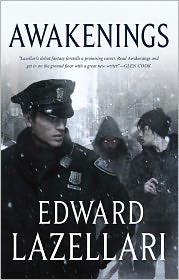
Book Review: "Awakenings" by Edward Lazellari

You might think, by looking at the cover, that Awakenings by Edward Lazellari is your standard paranormal fiction. But I was reminded of more traditional fantasy, in the vein of Terry Brooks in a modern setting, rather than something by Jim Butcher.


Cal McDonnell is a NY city cop who has no memory of his life prior to thirteen years ago. Despite his retrograde amnesia he has managed to carve out a meaningful life for himself that includes his job and a beautiful wife and daughter. Seth Raincrest also has no memory before thirteen years ago, but he hasn't had the same success in rebuilding his life. He ekes out a living as an amateur pornographer without forging any lasting relationships with anyone but his cat. But Seth and Cal share a past that is rapidly catching up with them as dangerous, and magic wielding, enemies from their former lives have found them and plan to attack before they can regain their memories.


Thirteen-year-old Daniel Hauer is the adopted child of Clyde and Rita and to say he grows up in an unhappy home is an understatement. Clyde is a mean drunk who resents being Daniel's stepfather and looks for any excuse to take it out on Daniel physically. But what neither Daniel or his parents know about is his noble heritage; one that ties him to Cal and Seth. But the same people that are hunting the others are now on Daniel's trail, and the people who want to keep him safe don't have any idea where he is-- or what name he goes by.


Edward Lazellari has a deft writing style which makes "Awakenings" a very absorbing book right from the start. Throw away characters are given a distinct personality in a just a few lines and the mystery surrounding Cal and Seth's amnesia certainly keeps you turning the pages. However there isn't a lot of mystery-solving that goes on as the story progresses. We do find where Seth and Cal come from and why they have amnesia, but much more time is spent on the set-up of the story that the reader is left with the feeling that they should know so much more.


"Awakenings" is also busy book, in part because there are at least five disparate story-lines that all connect at various points along the way. That alone wouldn't make "Awakenings" a confusing book, but throw in several interconnecting dimensions of varying magical and scientific resonance and some haphazard political machinations, and you have a book that can confound the most astute reader.


First, you have the p.o.v. of the three main characters, Cal, Seth and Danny, who are tied together by a mysterious past that is only partly explained throughout the book. Then you have the bad guys, led by the somewhat stereotypical Dorn who believes that a strong leader only uses fear as motivation. Then you have the good guys as initially represented by Lelani, a mysterious sorceress who tries to reach Cal and Seth before Dorn and his dangerous minions launch their attack. Adding to the various perspectives presented in the book are Cal's wife and a private detective hired to find Cal, Seth and Danny. It's amazing the book isn't more confusing than it is.


But if I had to pick the one thing that may have ruined the book for me, it's the fact that one of my literary deal breakers reared its ugly head several times in the book in the form of some politically slanted content. If I had to guess I'd say Lazellari is a very liberal guy. The first thing that jumped out at me was the fact that Cal's wife Cat seems somewhat fixated on her feminist values. Every time she muses on any situation that arises-- whether it's a crisis or not-- she definitely worries that her place in the world as a feminist is assured. Whether she goes back to work or ends up in the magical world Cal comes from-- she wants it known she's a feminist. And I have to say that, from my point of view, that even the most die-hard feminist isn't going to worry about such things when they're faced with life-altering problems: So it's not only unrealistic, but tiring. And heaven forbid you're a (gasp!) republican. Maybe it's me, but I find it strange to see more than one random comment regarding republicans pop-up in fantasy fiction: You'd think republicans don't read fantasy or something. Add to that a chapter that seems necessary only to insert some stereotypical slams against fundamentalist Christianity and you've come pretty close to a book that resembles Stephen King's recent work.


Another minor quibble I had with "Awakenings" was the issue of certain credibility gaps. For example, I'm pretty sure a four-hundred pound centaur isn't going to fit into the back of a Ford Explorer (with three or four other passengers). Maybe I'm just being petty, but I couldn't let that one go. Nor do I think the same centaur could get around a New York City apartment without knocking over a lot of furniture.


Despite the presence of some content that might normally make me walk away from a book, I finished "Awakenings" because the slant wasn't overwhelming and I wanted to see where the story was going-- so I have to say that Lazellari does a good job of keeping the reader interested. And I have to give credit to some really good writing when it comes to the action sequences. I thought the fight scenes were absolutely captivating. But in terms of payoff, there really isn't one where this book is concerned. Some of the back-story is sorted out but mostly the book reads like 350 pages of plot set-up. I really feel that the story could have been condensed into 200 pages, which would have allowed the narrative to progress more and prevent the feeling that you're only just getting to the meat of the story as the book ends.


The impression I was left with after finishing "Awakenings" was that Lazellari is a good writer who might benefit by toning down the politics, which might allow him to move the story more. Regardless of your political affiliation, it's distracting to have a story take unnecessary detours. To me it seemed as if he was pleasing himself by injecting some bias rather than writing to the story, and the book suffered for it.


3 out of 5 stars.

Monday, August 8, 2011

"Hounded" by Kevin Hearne-- Lighthearted, Funny Urban Fantasy

Pillow talk in the modern era often involves the sharing of childhood stories or perhaps an exchange of dream vacations. One of recent partners, a lovely lass named Jesse with a tattoo of Tinker Bell on her right shoulder blade (about as far from a real faery as one can get), had wanted to discuss a science-fiction television program, Battlestar Galactica, as a political allegory for the Bush years. When I confessed I had no knowledge of the show nor any interest in getting to know it or anything about American politics, she called me a "frakkin' Cylon" and stormed out of the house, leaving me confused but somewhat relieved.


~Excerpt from Hounded: The Iron Druid Chronicles by Kevin Hearne


With the current glut of paranormal fiction finding something new is almost as important as finding something good. Thankfully, "Hounded" by Kevin Hearne is both.


Atticus O'Sullivan is a very old Druid-- born before Jesus old-- and the last of his kind. He looks twenty one and happily plays the part of the slightly daft owner of an occult apothecary/bookstore. But Atticus (or Siodhachan as he's known to the Celtic gods) has been dodging Aenghus Óg, the not-so-loving Celtic god of love and poetry, for centuries over the possession of the sword Fragarach-- also known as "The Answerer."


But something bigger is brewing than a fight over a sword. Whatever Aenghus Óg has in mind is stirring up all of Tír na nÓg and suddenly Atticus finds himself with a bevy of goddesses showing up on his doorstep-- and none of them are telling him the truth. Thankfully Atticus has his faithful Irish wolfhoud Oberon (who can speak to Atticus through a telepathic link) and his team of lawyers (vampire and werewolf) to help him fight a battle that's beginning to look a lot like a full-fledged war between the gods.


"Hounded" is a highly-quotable blast of a book. It's by turns silly, lighthearted, full of action and has tons of pop-culture references sure to appeal to the geek in all of us. It's the kind of book most readers of paranormal fiction "get"-- as you will see from the Amazon reviews. There are a few readers who complain that Atticus is far too fun-loving to be a two-thousand year old Druid, but I thoroughly enjoyed the fact that, for once, our hero isn't the angst-ridden protagonist that comes along in almost every book I read. But I don't mean to give the impression that Hearne's book is something like the ultra-silly fiction written by MaryJanice Davidson or Janet Evanovich written from a guy's point of view--because it's not. Atticus isn't an incompetent hero, he's just a hero who isn't conflicted about his place in the world. He's still living because he wants to and he's going to enjoy each day as it comes. He likes teasing his friends and he has an active libido, but he's also the kind of guy who doesn't back down from a fight.


The charm of "Hounded" comes from many elements. The sense of humor is a huge part of its appeal, but the Druidic aspects do set it apart from all the other books that primarily focus on vampires, werewolves and witches. Granted, I wouldn't know if the Druidic aspects were in any way accurate, but they give the story a different focus than others of its kind and there's something deeply appealing about a philosophy that is connected to the earth and non-judgmental about different beliefs.


The banter between Atticus and his dog Oberon is very enjoyable as well.


*Did Genghis Khan take his coffee black?* Oberon asked me. After my bathtime story, he wanted to be the Genghis Khan of dogs. He wanted a harem of French poodles, all of whom were named either Fifi or Bambi. It was an amusing habit of his: Oberon had, in the past, wanted to be Vlad the Impaler, Joan of Arc, Bertand Russell, and any other historical figure I had recently told him about while he was getting a thorough cleansing. His Liberace period had been particularly good for my soul: You haven't lived until you've seen an Irish Wolfhound parading around in rhinestone-studded gold lamé


I wish I had a dog with that much personality.


If you prefer your heroes to be the broody type, then "Hounded" isn't your kind of book. But if you prefer your escapism light and action-oriented, then you should like "Hounded" as much as I did.


4 out of 5 stars.

Wednesday, July 6, 2011

DNF Review: "The Demon Trapper's Daughter" by Jana Oliver

I've never done a DNF (did not finish) review before-- usually I don't get far enough into a book I don't like to actually qualify it as review material. But Jana Oliver's The Demon Trapper's Daughter is unusual in that I made it most of the way before giving it up as being too irritating to be worth the effort to finish.


Obviously you don't need to read this whole review to know what my final verdict will be.


"The Demon Trapper's Daughter" is the story of Riley Blackthorn, the daughter of a well-known demon trapper who wants to follow in her father's footsteps. At seventeen Riley has been training as an apprentice to her father long enough to be trusted to trap a minor demon on her own. But her fist solo trapping goes awry as it becomes clear that two demons are working together and, even worse, they seem to know Riley's name. Riley thinks things can't get worse as video of her escapades hits the net, but another fatal collusion between demons leads to her father's death.


Alone in the world Riley knows the only thing she can do to survive is the become an independent trapper, but she must first finish her apprenticeship and her new master not only hated her father, but doesn't think woman are capable of working as trappers. But becoming a master trapper is only the first of Riley's challenges: she must also stand vigil at her father's grave for twelve nights to prevent necromancers from animating and selling her father's body; and sort out her feelings for two young men-- one of whom she's had feelings for since she was a child.


"The Demon Trapper's Daughter" has a lot of interesting premises. In this dystopian world angels, demons, Heaven and Hell aren't a matter of faith, but known for a fact to exist. It isn't spelled out when the demons first appeared, but the world has significantly changed. Everything is extraordinarily expensive and school is held in old coffee shops and grocery stores. Demons range from harmless little magpies that steal odd items from your home to monstrosities that have to be hunted down with holy water and lots of weapons. And it was the mythology that kept me interested long enough to really give this book a go.


However, as I got further into the story I kept getting distracted and irritated by the YA elements that Oliver kept throwing into the story to keep the young adult label, and the incongruity of that with the book's more adult content. Because Riley is seventeen the story is littered with the requisite teenage dramas of boyfriends and bullies and that would be fine if it were balanced well within the story; but it's not. For a book that's targeted at young adults, there is a lot of profanity and frank sexuality. We don't get sex scenes, which might explain how the book keeps it YA designation, but it's definitely a book for older teens at best.


But I persevered beyond the language despite my feeling that it wasn't right for the age designation because I kept hoping for the payoff. There were a couple of different mysteries within the story, one concerning the holy water and another regarding a reality-TV show about Vatican sponsored demon hunting, that had the potential to go somewhere. But as I reached the last fifty pages of the book too many annoying distractions took away my ability to care how the story resolved itself.


One of my main beefs with "The Demon Trapper's Daughter" is the constant insistence that women would be regarded as less able to hunt demons. It just doesn't jibe with a rough demon infested world that anyone capable of handling a weapon is going to be disregarded because of their gender. It just seemed contrived to appeal to an audience that would likely be largely female and addicted to "Twilight." But the coup de grâce for me was the random introduction of too many "hot" guys who are destined to flirt with the main character. We already had two love interests in the first two-thirds of the book, so when the story edges into it's final chapters there seemed no reason to bring anyone else into the mix. I'm sure the character had something to do with at least one of the mysteries that needed to be solved, but his appearance was too abrupt, too convenient and totally off-putting.


I admit that I am not a huge fan of YA fiction that gets into the whole does he like me or doesn't he like me? mold. But I can overlook teen angst if the story is interesting enough. Books like The Hunger Games and Divergent worked for me because there was a logic to the story as well as a good emotional payoff. But "The Demon Trapper's Daughter" jumped around too much for my logic-loving brain and didn't strike the right chords for me emotionally to make it work.


Despite my reservations, this book seems to be a big hit among the teen crowd, if the reviews on Amazon are any guide (it's probably the language); but I suspect that most adult readers looking for a nice paranormal diversion would probably be better served by avoiding this one.

Monday, July 4, 2011

Book Review(s): "Magic Bites" and "Magic Burns" by Ilona Andrews

One of the benefits of an extended vacation is the ability to catch up on books you've been meaning to read but never got the chance. I'm a 'beach-read' kind of person while on vacation because I'm far too easily distracted to concentrate on anything too involved; which is why paranormal fiction becomes my go-to genre on these occasions. Having been a fan of The Edge series by Ilona Andrews it was a no-brainer to pick the first two books in the Kate Daniels series for my leisure time reading this time around.


Magic Bites was the first book published by the husband and wife team of Ilona Gordon and Andrew Gordon who write under the pseudonym Ilona Andrews. Set in a future Atlanta Georgia that is radically changed thanks to magic waves that "crash" and alternate with technological waves that render technology and magic supreme at different times. When the magic is high gasoline-powered cars lose function, along with everything else technological, and magical creatures roam the night. In the new world the two most powerful groups are The People and The Pack. The People are a secretive group of necromancers who have the ability to "pilot" vampires through a strong mental control that keeps their blood-lust in check-- though the loss of that control will send a vampire on an uncontrollable feeding frenzy. The Pack is a tight hierarchy of shapshifters who must join The Pack or risk "going loup" when the first change comes at adolescence and the urges of the change rip apart their sanity.


Kate Daniels works as a mercenary who is often called upon to help in cases of magical emergencies. Armed with a saber appropriately named Slayer, Kate is a mysterious bundle of magical ability and attitude. When Kate's mentor is murdered Kate finds herself entangled with both The People and The Pack as both groups are caught up in a series of related murders that may send both groups to war with each other. The strength of Kate as a main character, and her saving grace, is her heart. She might throw out some sarcastic remarks but she has strong personal integrity and tons of compassion. Her magical abilities aren't really spelled out beyond the understanding that she inherited a magical legacy of some sort and that the magic is so strong in her blood that anything with her blood on it must be burned or it can be used against her. She does some neat tricks with her sword and has the ability to use "power words" that give her a certain command over other people, but the extent of her power isn't clear.


"Magic Bites" is, in some respects, boilerplate paranormal fiction. Kate is written in the now typical kick-ass heroine vein full of smart-alec remarks and the ability, or willingness, to take on all comers. But the overall package offered in "Magic Bites" takes it a level above the standard paranormal fare. What makes this books (and series) is the overlap of magic and technology. It's a bit confusing at first as the narration of the story offers tidbits about how the world functions in bits and pieces and it isn't clear for awhile how far into the future the story is set and how the magic first appeared. But the overlap is so intriguing and imaginatively done that it's difficult not to be impressed by what is created in this story. There's a terrific sense of anticipation as you read the book and wait to see what mythological creature is going to appear next.


However, there are times when "Magic Bites" does read like a debut novel. There are a lot of characters thrown at the reader and the story jumps around just enough to make the overall flow somewhat confusing-- you will find yourself backtracking to reread previous paragraphs in order to figure out where the story may have jumped or if you missed something. And while I think that books by Ilona Andrews make more effort than most to bridge logic gaps that are common to fast-moving paranormal fiction, there are times when the narrative doesn't make sense on a logical level and it feels as if certain elements are thrown in for emotional impact without ironing out the wrinkles. Those looking for paranormal romance will be somewhat disappointed because the romance angle is almost non-existent, though there are hints that it will materialize eventually.


Overall I liked "Magic Bites" though I find myself torn on what kind of grade to give it. I guess I'd give it 4 out of 5 stars for likability and imagination and 3.5 stars for execution.


The second book in the Kate Daniels series, Magic Burns, shows good growth in the series and smooths out some of the rough edges that detracted from the first book. Kate, now working as a liaison between The Mercenary Guild and The Order of Merciful Aid, is asked to look into what initially appears to be a simple theft of some maps belonging to The Pack and ends up trying to find the missing mother of a teenager. Kate's investigation leads her to a coven of witches who worship a Celtic goddess who have gotten in over their head due to their inexperience and may have attracted the attention of a god who wants to set a horde of demons loose in an attempt to destroy humanity.


"Magic Burns" gets further into the mythology of the series and we finally get some insight into how magic first began to appear-- and why-- as well as further explaining how The Pack and The People operate. Most of the secondary character development focuses on The Pack as Kate's potential love interest is Curran-- The Pack alpha who also happens to be a massive lion in his shifter form.


There's a lot to like about "Magic Burns." The relationship between Kate and her teenage charge is sweet but not cloying as Kate doesn't go the mother route and instead settles on "crazy aunt Kate" as her role in the kid's life; though she does frequently refer to the child as "my kid." The Pack is also interesting as we get a glimpse into the various groups including the were-hyenas and their particular kinks. Somehow the book manages to make were-creatures and vampires interesting in an over-saturated genre. But my favorite thing is something that all the books by Andrews features particularly well-- the magic. Every myth, every religion, every magical thing you ever heard of has the potential to show up and I love it. Whether it's a mobile-home park gone crazy, high-rises that turn to granite or crazy mermaid-like creatures with prehensile hair, there's always something new jumping out at you.


The only negative I'd give the series is the super slow reveal of certain plot points. As before the romantic elements are beyond anemic, but that doesn't really bother me. Many allusions are made to Kate's heritage and it's easy to make some educated guesses about her parentage, but so far Kate's mostly a cipher. The main revelations are limited to The Pack and the magic system of the series.


There is still a tendency toward a lot of busy action but overall I'm really liking the Kate Daniels series. I'm home now and have my nose buried in book number three. I could nit-pick here and there, but I'm still of the opinion that the writing team known as Ilona Andrews writes some of the most enjoyable paranormal fiction on the shelf right now. "Magic Burns" gets a solid 4 out of 5 stars.

Sunday, June 5, 2011

The Most Challenging Thing I've Ever Read

I don't know about you, but I tend to blog in waves in which certain themes pop up with some regularity until I feel like I've exhausted everything I have to say on the subject. Hopefully I don't exhaust those who read this blog in the process.


So, going along with the trend I started with Literary Deal Breakers and continued with the subject of Rape in Fiction, I began to think about the most disturbing book I ever read. I've talked about books I choose not to read once certain things occur within the story, but that doesn't mean I walk away from everything that makes me uncomfortable.


I read a book about three years ago that left an indelible mark on my psyche-- so much so that I don't ever have to think twice about which book I would say was the most troubling thing I have ever read. Surprisingly it wasn't something that was full of graphic violence. It wasn't a horror novel like something written by Stephen King. It was a psychological thriller called "Neuropath" by Scott Bakker, and it pushed the boundaries of what I'm able to tolerate so much that I wanted to scrub my brain when I was done.


As I look over the review I wrote for "Neuropath" (shown below) I realize that, if I were to try to read this book now, I'd probably walk away. But then again... The thing is, the content that really bothered me didn't show up until I was at least halfway through the book; and by then I HAD to know what was going to happen. Not gonna lie-- I should have just put it down.


Have you ever read anything that left you feeling as if you ended up with a bruised psyche? Something that kind of...hurt? That's what this book is to me.


What stories, if any, have scarred you?


Ignorance is Bliss.


If I could come up with one phrase to sum up my feelings after reading Neuropath by Scott Bakker it would be ignorance is bliss.


Why?


Because Bakker's novel is relentless in that it won't let us sit back and accept all the assumptions we have made about ourselves. Not just ourselves as individuals, but us as human beings. If you have ever sat back and thought about all the big questions: What is consciousness? Are we more than a bundle of bone, muscle, nerve endings and brain tissue? Do we rationalize an existence beyond this life simply because we are too afraid to contemplate the alternative? Are emotions like love, shame, fear and desire real, or are they simply evolution's way of making sure we, as a species, continue to procreate and survive?


Those are all questions that Bakker weaves into a novel that is by turns thoughtful and horrifying.


"Neuropath" follows the story of Professor Thomas Bible, a psychology professor at Columbia, who is still trying to pull his life together after his divorce. One night, his best friend and college roommate Neil Cassidy, drops in with a bottle of whisky and a confession; he's been secretly working for the NSA interrogating terrorists with a new science that allows him to turn off neural switches in the brain that literally makes the terrorists want to tell him all their secrets. These revelations renew discussions about The Argument that Neil and Thomas had debated throughout their college career. The Argument is, at its core, the idea that free will is an illusion. That we are nothing but meat puppets who believe that consciousness is real and that we will rationalize our self awareness no matter how much evidence we see to the contrary.


After a drunken night of disturbing revelations, Tom manages his bleary way into work the next day where he is confronted by FBI agents who have a video of a crime that is beyond heinous-- and Neil is the main suspect. After that Tom's life is literally thrown down the rabbit hole. All the assumptions he had made about his life, his marriage and his friendship to Neil are turned inside out. And not only does Tom have to confront a lot of uncomfortable truths, he has to help the FBI get inside the head of Neil Cassidy; something Tom is uniquely qualified but reluctant to do.


The Argument isn't a new philosophy, but Bakker doesn't let it lie as nothing but an abstract discussion, he brings science to the conversation to back him up. The book takes place in a not-so-distant future, though Bakker doesn't specify exactly when. So the science that may or may not prove The Argument is more than simple philosophy isn't fully developed; but it is developed enough to put most of our assumptions about existence into question.


In many respects this is the hardest book I've ever had to review. There's no question I highly respect what Bakker has done here. This is a book that makes you think, hard. It is also totally uncompromising. Let me explain.


The villain in "Neuropath" is not only convinced that we have no free will, he's on a mission to prove it. High profile people who stand for something, whether it be religion, politics or even sex, are kidnapped so that they can be used as living examples that demonstrate the truth of The Argument. I was often reminded of the movie Se7en as each kidnap victim, and the results of their torture, is revealed. The only difference here is that instead of making a statement about sin, Bakker is making a statement about free will. But Bakker's statement goes beyond the shocking images we saw in the movie "Se7en" because he brings children into the mix.


I understand why Bakker chose not to exclude that which most of us find completely repugnant-- children as victims. If one is to fully give in to The Argument, as we are to believe the villain in "Neuropath" has, then there is no reason that children would be exempt from the atrocities committed. There is no moral high ground here because morality is an illusion, just as every part of consciousness is illusory. However, by using children as part of mix, Bakker takes the book to whole different level of disturbing. I have children myself and seriously considered putting the book down because it hit too close to home.


But I continued to read. Why? Because I wanted to see how The Argument ended; at least within the context of the story. But Bakker isn't about Hollywood endings I can't claim to have walked away from the book satisfied. Instead I walked away disturbed.


Now, I won't say I lost any sleep over this book. I didn't. I think this is because I put the book down frequently in order to ponder the philosophy within. As Bakker himself states his belief in free will in the Afterward of his book, I also choose to believe that we have free will. I choose to believe that our consciousness is more than an illusion. I can't claim to have any proof to back up my belief, but after reading the book I don't believe that science or the book "Neuropath" have proven, yet, that we are nothing more than animated bundles of firing synapses. In fact, that is what I think is the fundamental flaw in an otherwise exceedingly well thought out book. There is no real opposition put up against The Argument.


I don't know about you, but I need to hear both sides of an argument to pick a side--usually. I won't accuse Bakker of creating a straw man argument here though, there's too much science and philosophy to back the assertions made in creating The Argument. But every time it is presented in "Neuropath" it is presented almost as a fait accompli. Which is a shame because there is no character more perfect to show the contradictions between belief and action as Thomas Bible. In fact, there are many times that he, despite his apparent belief in The Argument, beseeches God to intercede on his behalf-- despite an absolute belief in the futility of prayers. The contradictions in human nature and science are never demonstrated as clearly as in those moments. But the moment that I really was waiting for, the moment where Thomas abandons his reasoning, his Argument, out of desperation for his family, never happens. Therefore The Argument loses some of its impact because of its lack of opposition, and that lack left me feeling the culmination of the book was missing the full-circle it could have had.


This is a work that is worthy of respect though. The amount of philosophy packed within it's pages is profound, though overwhelming at times, but it will force you to think. It will disturb you for a lot of reasons, not the least of which is that Bakker creates characters that are relatable and you will connect to them; making the tragedies they suffer more powerful. "Neuropath" is a thinking man's thriller and there's no doubt it will make you question some of your most fundamental beliefs.


Perhaps leave you with the feeling that, indeed, ignorance is bliss.

Tuesday, May 17, 2011

Book Review: "Divergent" by Veronica Roth

"They don't want people to listen, they want people to agree[...] And you shouldn't bully people into agreeing with you."


~Divergent by Veronica Roth.


In Beatrice Prior's dystopian Chicago, society is divided into five factions, each dedicated to the cultivation of a particular virtue—Candor (the honest), Abnegation (the selfless), Dauntless (the brave), Amity (the peaceful), and Erudite (the intelligent). On an appointed day of every year, all sixteen-year-olds must select the faction to which they will devote the rest of their lives. For Beatrice, the decision is between staying with her family and being who she really is—she can't have both. So she makes a choice that surprises everyone, including herself.


During the highly competitive initiation that follows, Beatrice renames herself Tris and struggles to determine who her friends really are—and where, exactly, a romance with a sometimes fascinating, sometimes infuriating boy fits into the life she's chosen. But Tris also has a secret, one she's kept hidden from everyone because she's been warned it can mean death. And as she discovers a growing conflict that threatens to unravel her seemingly perfect society, she also learns that her secret might help her save those she loves… or it might destroy her.


Debut author Veronica Roth bursts onto the literary scene with the first book in the Divergent series—dystopian thrillers filled with electrifying decisions, heartbreaking betrayals, stunning consequences, and unexpected romance.


I always say I don't read much YA fiction-- and that's true-- but it seems that every year one YA title manages to captivate me-- and this year's book is "Divergent" by Veronica Roth.


Dystopian themes seem to be fairly hot in YA fiction but "Divergent" doesn't spend a lot of time dealing with the end-of-the-world aspects of the story. The collapse of society as we know it is the set-up, but what really impressed me about this book was the way Roth takes topics that are very common in YA fiction, like the conformity of cliques and finding one's individuality, and giving them uncommon depth.


We don't know what precipitates the decline of modern civilization, but the solution presented in "Divergent" involves dividing people into groups based on their most prominent personality traits with the intention of creating the ever impossible Utopian society. As always happens in this kind of scenario the various factions become suspicious of each other and the plotting begins.


Tris grows up largely unaware of the tensions that exist between groups because she has grown up mostly isolated within the faction of her birth. But she does know that she isn't sure she belongs in Abnegation even though she has spent her whole life there. When Tris does choose a faction (a spoiler I won't reveal here) she not only learns a lot about the political rifts that have developed between groups, but also that conformity to one's chosen traits is a matter of life and death.


When I first started reading "Divergent" I was tempted to try to compare it to other books. I looked at the factions that Roth describes and began to think Harry Potter. Are the Dauntless supposed to represent Gryffindor? I mused. But those comparisons fade as the depth of the narrative becomes clearer. What I liked best about Divergent" is that while each group could potentially stand-in for the cliques we remember from high school (the geeks, the jocks, the rebels etc.,) they are also very relatable to the adult reader as surrogates for the political jockeying and misinformation we see blasted out the cable networks everyday. The story quickly goes from just entertainment to a pointed reminder that it's not whether or not we're willing to challenge the assumptions of other people that matter, but whether we're willing to challenge our own. "Divergent" also had me tempted to make comparisons to "The Hunger Games" because Tris was such a strong character. But Tris is a fully realized heroine and easily stands up the best characters to show up in YA fiction.


"Divergent" isn't a perfect book. While the action is well paced there were a few times I was forced to admit that the confrontations between the heroes and the villains were very stereotypically written. One sequence in particular has that James Bond flavor of setting the scene in which the hero is put into a fairly silly, over complicated trap reminiscent of tying Bond to a table and aiming a laser at him-- while the villain walks away. Like that. I also wished that Roth had gone into some detail as to what led to the breakdown of society and how widespread it was as the story is set in Chicago and makes no mention of whether or not it is the only city left standing- but I do have hope that this part of the story may be expanded upon in the future.


But "Divergent" is one of those books that has such a huge emotional payoff that you don't mind the flaws in the narrative. Roth takes messages that are often inserted into YA fiction and makes them relevant to any reader. I loved how she showed that any kind of behavior, no matter how rebellious it seems, can be a type of conformity-- and how dangerous that is. And that making assumptions about people as a "type" makes it so easy to make them an enemy. Honestly, most adults I know need to be reminded of these things more than any teenager I've ever met.


I couldn't put "Divergent" down. It's just a very satisfying read that leaves you hungry for the sequel.


4 1/2 out of 5 stars.


Veronica Roth Website (Quick aside-- I just read that Roth is 22 years old! I am seriously impressed.)

Wednesday, March 16, 2011

Book Review: "Among Thieves" by Douglas Hulick

Among Thieves: A Tale of the Kin by Douglas Hulick

Roc

432 pages


Anyone who reads this blog may know I finished this book about two months ago and I've been raving about it ever since. I waited to post a review because I didn't want to put this up too soon and have you forget about this title-- because I'm recommending it for sure. But we're closing in on just a couple of weeks until the April 5th release date-- and I want to get the buzz started on this one (as if I have that kind of influence). You'll thank me later.


Drothe is a member of the criminal world of the Kin. Known as a Nose, Drothe is an information gatherer by trade. He works the criminal underworld of Ildrecca and sifts through the information that might be useful to the crime lord he works for. But for all the dangers a Nose might run into while trying to navigate the dangerous world of the Kin, it's Drothe's side business of selling relics that proves to be the most deadly.


Drothe's latest attempt at moving a relic gets unusually complicated as some dangerous people start trying to get their hands on it themselves. And while Drothe is trying to figure out that puzzle, rumors of a war within different factions of the Kin begin to start gaining momentum. Drothe tries to put them off as idle speculation, but it isn't long before he gets sucked into the middle of a turf war. And the relic, which just happens to end up in Drothe's hands, is right at the center of the fight-- and a lot of powerful people want to get their hands on that relic.


"Among Thieves" is a fooler. You'll look at the cover and think it's just an average fantasy debut. You might pass it up because it doesn't have the buzz we've grown accustomed to when authors like Patrick Rothfuss or Joe Abercrombie made their well publicized entry into the genre. And all I can say is-- I'm baffled that "Among Thieves" hasn't had more buzz surrounding it. It's a really good book. So good that I was inspired to write this post outlining what I like in fantasy fiction-- and why "Among Thieves" met every criteria.


But since this is the official review, I'll go over some of those points again.


Fantasy can be tough because creating a new world with all the trappings of fantasy, including magic and the social/political structure is hard to make believable. Too many authors are tempted to fall back on the template set up by authors like J.R.R Tolkien or go so far afield that there isn't much for the reader to grab onto as things get really weird. But Douglas Hulick finds a balance that is just right in the world he creates for "Among Thieves." We've all read stories about assassins and thieves in our favorite fantasy, so it's a bit of a challenge to create something we haven't seen before. So Hulick does the smart thing and doesn't try to start from scratch. He uses the "cant" or thieves' argot drawn from Elizabethan England and Twentieth Century American-underworld slang as a foundation for the language and culture and extemporizes from there-- and it works. The culture and politics are Hulick's own, but the commonality of language lends a sense of credibility that makes the whole structure really solid.


Magic is also tricky in fantasy. I like magic that is there, but not overwhelmingly so. What I liked about how the magic is used in "Among Thieves" is that it's there, but not easy to use or cheap to buy. Drothe is a thief who also has useful magical ability that was handed down to him from his stepfather, but it's a subtle gift with some downsides that make it a hindrance to anyone who isn't up to no good. Kulick does a good job of establishing what the boundaries of the magic are without hard-to-follow info-dumps and I liked how it never interfered with the flow of the larger story.


And when it comes to the most important part of the story (in my opinion), the characters, Hulick does a terrific job. One of my main complaints with popular fiction is the temptation to use stereotypes to build characters and the unfortunate result that the characters never move beyond outlines of familiar personalities. Drothe, as a thief who is cast as the hero, is a well known personality in fantasy fiction. But Hulick does a very good job of establishing Drothe as someone who finds the honor in a largely dishonorable world. I liked that the story existed within the confines of the criminal underworld. The thieving and scheming exists in a place where people know the rules and act accordingly. But most importantly, each character has a distinct set of characteristics and motives.


The story structure was also exceptionally well done. I appreciate that Hulick didn't rush the story. The hunt for the relic that is integral to the plot isn't treated as an aside and the narrative is allowed to grow and develop at a natural pace. Other, smaller things also tickled my fancy when it came to "Among Thieves" as well. For example, Hulick doesn't use a lot of profanity, which is kind of refreshing given the frequency it seems to be used in modern fantasy these days. There is plenty of content that could be referred to as "gritty" -- to use the most overused adjective in reviewing today-- but nothing that doesn't fit perfectly into the story. I'm also not a huge fan of prose-heavy writing, so I liked the straight forward style of Hulick's writing. If I could think of the biggest compliment I would give a writer, it would be to say a book is seamless. And in my opinion-- "Among Thieves" is seamless storytelling.


Don't let the fact that this is a humble paperback release fool you-- this is a book worth mentioning. And I sincerely hope it gets the attention it deserves.


5 out of 5 stars.

Tuesday, December 7, 2010

Book Review: "The Hundred Thousand Kingdoms" by N.K. Jemisin

I've been in a reading rut. I'm sure you know what I'm talking about. I pick up a book, read half, and then lose interest. The books I've been trying to read have been good too-- really good. Sometimes, though, it just doesn't matter. The mind doesn't quiet and just finishing something, anything, seems like a massive hurdle. So it was a relief to pick up N.K. Jemisin's debut novel, The Hundred Thousand Kingdoms, and find a book that broke through my funk and jump-started my reading back into first gear.


Following the murder of her mother, Yeine Darr is summoned to the city of Sky by her grandfather and told that she is now in contention for the throne. Sky is the seat of the powerful Arameri family who rule The Hundred Thousand Kingdoms with the power of captive Gods at their disposal. Following the Gods' war the Arameri became the chosen people of Itempas, currently the most powerful of the Gods. They also gained custody of the imprisoned Nightlord (Nahadoth), the God who lost the war and has been imprisoned in a human shell for thousands of years. Barely sane, Nahadoth is chained to the Arameri family and has destroyed entire nations at their command.


Yeine knows little of the world she is forced into. Her mother gave up the throne before Yeine was born and Dekarta, Yeine's grandfather, never forgave her for leaving. Yeine not only walks into the usual palace intrigues and debauchery, but has to navigate a world of mad gods and jealous magicians while trying to find out who murdered her mother.


I've read some reviews that say "The Hundred Thousand Kingdoms" is fairly standard fantasy due to the well trod storyline of powerful families and living Gods. But I think to say that is to miss what the book is about entirely. "The Hundred Thousand Kingdoms" is a book about how people connect and the needs that tie us together; and ultimately the main character, Yeine, is the heart of "The Hundred Thousand Kingdoms"-- everything flows through her. Early on we're introduced to Nahadoth and a couple other minor gods (known as "godlings") who are tied to and live in the Sky castle. My favorite thing about "The Hundred Thousand Kingdoms" has to be the various Gods and the prominent place they have in the story. Rarely have I read a fantasy that allows the Gods to be main characters without humanizing them too much, but here they are alternatively intriguing, alien and frightening in the way that Gods should be.


One critique that is valid of "The Hundred Thousand Kingdoms" is that the villains are rather boilerplate. They possess the kind of cruelty and indifference that are common to most 'bad-guy' characters. We're given enough background to understand that they have become that way thanks to unlimited power and no consequences. And the narrative does falter when Yeine comes to Sky and has the potential to upend the status quo and offer an alternative to generations of abuse-- and no one really seizes the opportunity. But there is a soulfulness to "The Hundred Thousand Kingdoms" that kind of transcends most of these considerations because, again, it's the feelings the characters evoke and the relationships that develop that mattered to me more than anything else. It's not the e-vil-ness of the villainy that we should be focusing on, but how it affects those it touches.


I really connected to "The Hundred Thousand Kingdoms." It may not be for everyone due to its unusual style. Jemisin opens each chapter with a a kind of stream-of-consciousness narration that doesn't make a whole lot of sense at first, but becomes clear as the story progresses. But I liked it because it's a nice change between that and the first person recounting of events by Yeine. I loved the feel of "The Hundred Thousand Kingdoms." Jemisin captures raw emotion in a way that worked for me and had many small moments that I thought were genuinely touching. There are times when the story can seem a bit convoluted but it never really strays into overly-complicated territory. It has it's fair share of suspense and mystery, but ultimately I'd recommend it for its soul.


4 out of 5 stars.